Friday, 23 November 2012

Not for the squeamish. Warning-parental guidance!


On Friday 26th October 2012 the Muslim population of Ghana celebrated Eid al-Adha and enjoyed a day of religious observation and family festivities.
The state schools and main institutions remained open, but in the predominantly Muslim northern regions of Ghana, attendance would be low and applications for leave of absence high. For the VSO volunteers working in education in the northern areas, as none are Muslim, the day presented an opportunity for a working meeting; catch up, exchange of ideas and planning session.
Opposite our venue ( a volunteer’s house) there is a courtyard housing the accommodation and businesses of an extended Muslim family: a corner shop opening onto the street, a chop bar making and selling cooked food, a fabric store and tailor’s workshop, fish and meat smoking fires, small livestock rearing and living spaces.
We were invited to watch the sacrificial slaughter and butchering of a calf, commemorating the Biblical story of Abraham, who in following God’s command was about to sacrifice his son, when ordered to replace the child with a ram. Why did I go? The family continued their daily routines about the courtyard while preparations for the sacrifice were made. The chosen animal was lead into the yard, lifted and lay on its side and the limbs tied together. It was lifted into a shallow pit, positioned with a small deeper hole next to its neck, dug ready to collect the drained blood. The family and invited guests gathered quietly to watch. The event had a purposeful calm about it.   I was curious, but starting to feel distressed. A sharp cutlass was rested against the calf’s hide. Gently the calf was held in position, and an incision made in the calf’s neck.


I was overcome with a surge of emotion, being present at the ritualised death of a living creature, and left the courtyard in tears. I was helped across the road and back to the volunteer house and offered the standard British antidote: a cup of tea and a sweet biscuit.
I later reflected that every scrap of the calf’s flesh and carcass would be put to good use, and that during its life, the animal would have enjoyed a degree of nurture and roaming unknown to the factory farmed animals, the majority of agricultural livestock, in the UK. Through reading and watching certain television documentaries, I have a little knowledge of meat production and processing in the UK, but no direct experience, and I had given the subject minimal thought, certainly nothing to match what I had witnessed that day. However, I decided that if I was to remain true to my response to the slaughter of the calf, then I should no longer knowingly eat meat. 

Sunday, 4 November 2012

Hot Wheels 5

Pit stop at a village

Hot Wheels 4


While the other volunteers picked up skills quickly and were able to practice, my progress was frustrated as I battled with the Yamaha 125 standard VSO moto.  After two days and three tumbles (no injuries bar bruises) I realised this machine was too big and too heavy for me. By good fortune, enquiries revealed that VSO had a smaller scooter in store, which was recovered, hastily serviced and by Friday I was much happier, sitting astride a Yamaha Economy Crypton, able to plant both feet on the ground, move the steering with ease and actually manoeuvre the bike back and forth when in neutral.


I had by then evolved my preferred practice routine, with a trainer “picked” as my pillion passenger, coaching and immediately available when I felt I had “had enough.” Our routes, along the main roads of Tamale, the rough dirt roads of the estates and out through the rural tracks leading to remote villages, were demanding of skills and concentration, exhausting, but exactly what was needed.
 

Hot Wheels 3

On the moto with trainer Abdul

Hot Wheels 2


After needing 7 days, rather than the 3 days suggested by VSO in the UK for initial “moto” (the Ghanaian term for a motorbike) training, I was understandably anxious as I set off on a Sunday with fellow volunteer Nicole to meet with two other volunteers for a week of intensive Ghana-style training.  Leaving Zebilla (population  3,000), travelling through Bolgatanga (population 70,000) to our destination,  Tamale, (population 350,000), some 100 miles by pot-holed roads, the contrasts between  large village, town and city felt stark, noisy and abrupt after the slow friendliness I have become accustomed to.

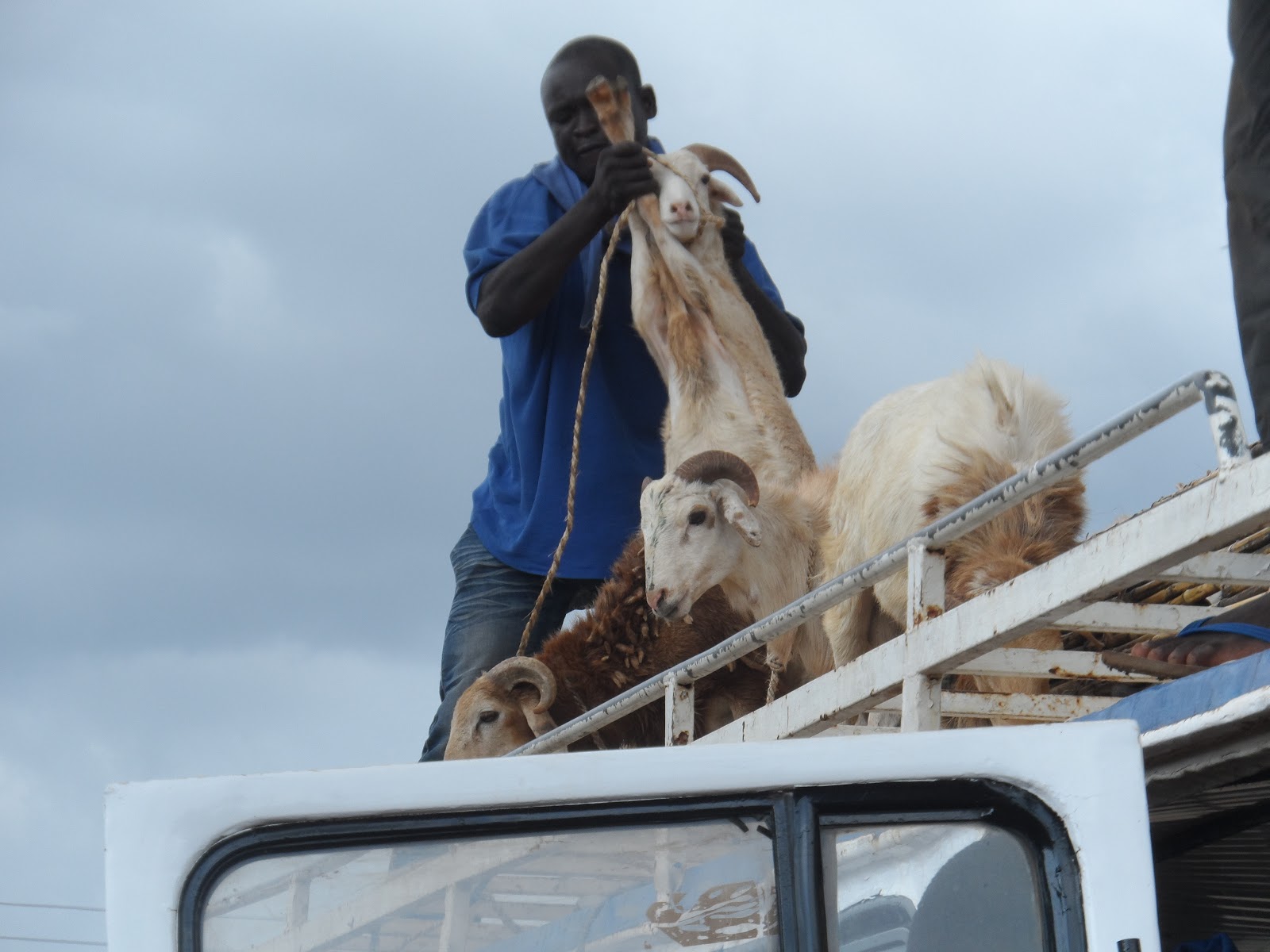
 As we inserted ourselves into our seats for the second and longer ride on the “tro tro” minibus, I thought, on hearing the sound of small hooves clattered over head, it was “The night Before Christmas”. More evidence of animals later, as the sagging, cracked ceiling above us revealed seepage, and droplets of brown fluid- goat urine and excrement-threatened passengers in the folding centre seats. ( Aisle space is an unaffordable luxury on a tro tro) One gallant man demanded the driver supply a cloth, and he dutifully dabbed and wiped for the three hour  journey to Tamale, while the goats on the roof skidded at every turn and jolt,  responding in nature’s way to their perilous positioning.
And so we arrived in the city of Tamale, found our lodgings, ate, slept, and then reported for a week’s Moto training on the Monday morning.

Goats on the roof

Hot Wheels


There are very good reasons why motorbikes feature as a main source of transport in northern Ghana:- the road network is minimal, with crumbling tarmac or red dirt surfaces; remote villages are linked by tracks too rough for regular cars and often too narrow for 4 wheel drive off- road vehicles; motorbikes are cheap to operate, easy to maintain and repair and respond well to the varying conditions of wet and dry seasons ; they quicker than cycling or walking.
A road in Zebilla

Tuesday, 23 October 2012

The wheels on the bus go round and round


………….except when one falls off!

Travel, travelling. The words conjure notions of glamour and excitement, fed by newspapers’ colour supplements, blogs from exotic places, endless images on Facebook and personal dreams of escape, of self-discovery, of adventure, of renewal.
A Metro Mass Transit bus
 

The journey from Wa to Bolgatanga, across northern Ghana, a distance of some 125 miles, supplies a little of the above.

A Metro Mass Transit bus
 A Monday before dawn. It is still pouring with rain, though the thunder storm has passed. I rise at 3.30 am to be ready for the taxi taking me to the bus park. On arriving, the driver checks where I am to wait: a concrete shelter housing sleeping bundles of cloth amid a muddy red dirt roadway.

By 4am, stall holders are appearing. Sheltering from the downpour under a MTN Mobile Phone sun umbrella, a woman kindles a fire, adding broken pieces of polystyrene for good measure. The wakening passengers shift to avoid the sickly smoke. Ready prepared porridge, brought in a recycled Dulux paint bucket, is poured into a cauldron suspended over the flames. My choice of breakfast will be “Egg bread”: an omelette seasoned and spiced with fresh tomato quickly fried over charcoal, then sandwiched between a soft baton of bread, split and toasted in the same pan, then slid into a small plastic bag.

The bus conductor appears- identified simply by a shoulder bag and small booklet with numbered tickets.  With patience and politeness, we wait in the rain. “Who is last?” announces a new arrival, checking where to join the queue. Slowly the bus fills with people and luggage.

 At 5.50 am the bus lurches out of the bus park. With 5 seats per row, configured in threes and twos, space is limited. I am nicely wedged between my neighbour and the window, so every bounce is absorbed in unison, as we quietly if fitfully doze.

The road (a generous noun) quickly deteriorates from rough tarmac to red dirt, softened and yielding after a night’s rain, doubling as a temporary stream bed with freshly scoured potholes. The bus creaks like a ship as it climbs over and around each obstacle, with a triumphant acceleration into third gear as a firmer smoother stretch of road is reached. The trip to Bolgatanga, with one break, otherwise stopping only to pick up and drop off passengers, should take about 9 hours, giving an average speed of 14 miles per hour, which is about the pace of an urban bus route in the UK.

However, this journey was destined to take all day and more. A sudden bang, the bus shifts to one side, and I glance through a mud smeared window to see a wheel rolling away from us. As the driver and conductor struggle to raise the bus and begin repairs they cannot complete, passengers are urged to “walk on ahead to the next village for refreshments.” Ha! Men crowd around the slumped bus, offering advice, mothers let toddlers run into the grass. I fall into conversation with a young teacher, Michael. We soon decide to follow others in straggling twos and threes along the road, as though to walk to Bolgatanga.

Eventually it is our turn to be offered a lift by a passing vehicle, one coming along every five minutes or so. After half an hour we pass the first village with the promised refreshments: the “No sweat, No joy” drink spot- closed, a covered stall with fresh local fruits and vegetables, the beaming smiles of candidates for the forthcoming general election plastered across walls and wandering domesticated goats, hens, sheep, cows and donkeys everywhere. After another hour, the replacement bus from Bolgatanga, heading to collect the driver, conductor and remnant passengers rattles past. Michael and I talk of education systems, taxation, religion, main political parties, housing and the differences between rural and urban living.

Ten and a half hours after setting off from Wa, we arrive in Bolgatanga and Michael makes sure I find my bus for the onward journey back to Zebilla, before we shake hands, exchange best wishes and he disappears into the busy crowd to complete his route home to Kongo.
In total, my journey takes fifteen exhausting hours. I try, like the people of Ghana do, to accept the immediate situation. I see that any chance is taken for conversation, for extending the hand of friendship; the funny side of a situation is shared with a full bellied laugh