Monday, 1 April 2013

Elmina castle


Elmina Castle.
While staying on the coast of Ghana, my daughter Rosie and I set aside a day for exploring the historic  Elmina Castle, with the help of tour guide Gideon and some useful written and picture exhibits in the military barracks, once the castle’s Catholic chapel.

Elmina castle, with high straight white walls, fixtures and features in black, has an appearance of elegance, peace and calm which belies its history. In three layers, with the airy spacious accommodation for the Governor and associates on the upper floor, the officers’ rooms, military barracks, kitchens services and places for religious worship in the middle and the dark storage dungeons beneath, a tour of each circuit in turn contrasts the lives and very different status of the occupants.

Elmina castle from the beach- photo- internet.

Within the castle- the governor's residence overlooks one side of the enclosed courtyard. The entrances to the dungeons are through low doors at the ground level.


Built by the Portuguese in 1482 from imported pre- fabricated sections, it is the oldest European building south of the Sahara. It first served to protect the trading port on what became known as The Portuguese Gold Coast, a tenth of the world’s gold being exported from this area annually in the 15th century.
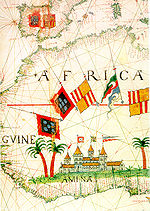
16th century map of West Africa showing  Amina- "a mine". (Wikipedia)

Within two hundred years trade had shifted and cargoes of captured West African slaves, first exported out of Elmina, became far more valuable commodities for the new colonies of Brazil, claimed by the Portuguese, and later also parts of the Caribbean claimed by the Dutch, who seized control of Elmina castle in 1637. By the 18th century, 30,000 slaves on their way to North and South America passed through Elmina's Door of No Return each year. The slaves came from northern interior tribes, captured and traded by particular African chiefs and kings who moved from the lesser rewards of dealing with Arab merchants. Thus Elmina played its part in what some scholars call The African Holocaust.


The Door of No Return- lead straight to awaiting small rowing boats, taking slaves to the larger ships. Photo- internet. 


As visitors to the castle, we were encouraged to imagine the different  conditions experienced by the slaves, as they awaited transportation, by the officer and service classes and by the governor and captain of guards, controlling the operations.

Males and females were separated, each slave dehumanised, a nameless commodity with no reference to kinship or marriage, locked into low ceiling stone dungeons, some 300 per room, measuring about 30 feet by 12 feet, any light and fresh air creeping through few narrow barred window spaces. Diseases of dirty water supplies, poor sanitation, insect bites and fetid air were rife. 

This dungeon would hold three hundred slaves.

The women’s courtyard could be viewed from a higher gallery, where the governor would take his pick of suitable concubines to satisfy his lust. Refusal to cooperate with any command was punished by chaining a cannonball to the foot and leaving a woman out in the courtyard, exposed to the merciless heat of the sun until she submitted. 


View of the women's exercise yard, from the governor's balcony.  Beneath the wooden trapdoor is the  well supplying water. (now disused). Any woman refusing to obey an order would be brought out, chained to a cannonball and left in the heat until she submitted.

Male punishment was singular- the offender was taken to the death cell, an alternative door of no return. 


Friday, 29 March 2013

Strike- Extra!


By Thursday 28th March teachers had returned to work.

But the children hadn’t.

I visited three schools during the day. I watched an impromptu game of football between the male pupils at Lamboya primary and junior, while the laughter of girls shaded from the heat in a classroom echoed along the empty verandah. Boys at Tanga village school were washing the teachers’ motorbikes at the school bore hole. Teacher Bartholomew, with 95 children on his Primary 2 registers (one each for boys and girls) was looking at a class of five. I seized the opportunity to catch up with data collection and analysis, following our screening programmes.

It would seem that the children were now On Strike!

Wednesday, 27 March 2013

Strike.


Teachers’ strike
Since Monday 13th March all teachers in the government schools belonging to the Ghana National Association of Teachers (GNAT) and the sister NAGRAT (National Association of Graduate Teachers) have been on indefinite strike
The timing of the strike- over a long running dispute concerning the non-negotiation of new pay proposals by the government, a freeze on increments since 2010 and other delays in payments- was deliberate, coinciding with the public exam period, when Junior High School pupils, at the end of 9 or more years of education take their Basic Education Certificate Exam (BECE), (success securing a place at Senior High School) while the Senior High School (SHS)students take the West African Secondary School Certificate Exam (WASSCE). (The WASSCE- a commonly managed exam across the Anglophone countries of West Africa is taken prior to higher or tertiary education application.) SHS head teachers have drafted in cooks and janitors to invigilate the WASSCE exams to avoid disrupting the schedule for students.
After two days, TEWU- the Teachers and Education Workers Union- representing administrative and support staff joined the dispute. All government schools across the country either closed or were barely functioning.


In a non-scientific, extremely partial straw poll of opinions, I spoke with some teachers I have been working with in Zebilla, to gain some understanding of the issues.
Pay continues to be a key issue- the much quoted “Our take home pay doesn’t take us home,” recurring. There are references to the low status of teachers, of the job being the last choice, not the first, for capable secondary high school and university graduates.  There are comparisons with health workers, nurses etc- also not highly paid, but with better pay, and in recent years improved working conditions which saw a surge in applicants for Nursing College places among young students. I was told teachers are paid a small “retention increment” while health staff are paid a higher “management premium.” While qualified teachers receive a salary, schools in the poorer north are largely staffed by unqualified Youth Employment Teachers, Pupil Teachers and Volunteer teachers, who are supposed to receive a regular small allowance for their services. One young Youth Employment teacher in Zebilla said there had been no money for a whole year. Newly qualified teachers with a Diploma in Basic Education “have not been placed on their correct salary scale… for almost a year.”
Underlying pay  and  poor conditions of service:- which for teachers in northern Primary classes can mean pupil numbers up to 100, a classroom with no furniture and few books or other resources, kindergarten classes taught under a tree;-low teacher morale is driving the resolve to support the strike. Teaching is regularly viewed as a “stepping stone” into another better paid, better respected profession.  Of the 10,000 who leave teaching annually, a third moves to the financial sector. And as only 9,000 teachers are trained each year, the current shortfall in teacher numbers, around 80,000 according to GNAT figures, will not be rectified.
After a week union leaders met with President John Mahama, discussed their grievances and as assurances were given, recommended to the area representatives that the strike action be suspended. Schools  began returning to normal activity by Wednesday 27th March.


The GNAT President, Solomon Doe Alodia told Citi News, “we have presented four main issues to government and as we speak now three of those issues are being addressed seriously. The only one that was not addressed we are supposed to meet the Fair Wages and Salary commission and begin negotiations.”

“Apart from that we have received two thirds of what we presented and we are grateful. If our concerns are not addressed on time we will revert our course,”


Friday, 22 March 2013

Independence Day 3

Soldiers in ceremonial dress parade the flag before the dignitaries.
Army cadets- including a significant number of women, and lead by a woman commander, observe the dignitaries as they march past.

Independence Day 2


A hundred children costumed simply in T shirts and carrying ribbons of the Ghanaian colours danced their routines with energy and joy. 

The uniformed school pupils, some in the tan and brown of the government schools, others in lemon, bright blue, banana yellow, emerald green or scarlet of the private schools of Christian or Muslim faith took their turn to march around the field, some adopting particular gestures or signals denoting peace, friendship or cooperation. 


In the centre of the field the band continued to play, the army cadets held position, an occasional individual collapsing in the heat and ushered into a waiting ambulance.

As the silver band plays, a pair of boots and a cap remain on the field, their owner  ushered into an ambulance after collapsing in the heat.

The various leaders addressed the crowd, Christian, Muslim and traditional African prayers were said, the army saluted and closed the event, then all slowly left the field to continue celebrations or return to the normal work of the day.

Independence Day- 6th March


Independence Day
On Wednesday 6th March 2013, Ghana celebrated its 56th birthday.
Ghana was the first African country in the British Commonwealth to gain post war independence. Although a quick scan through the record of elections, coups and changes of leadership suggest crises and upheavals, modern Ghana is a largely peaceful country with the last general election, in December 2012, conducted peacefully. (The resulting victory for the incumbent NDC continues to be contested by the main opposition party, the NPP.)
Aside from the official celebrations in Accra, throughout Ghana, local events, some prepared over weeks and months, take place both during the day time and into the evening.  Schools take pride in training pupils to march smartly, with daily rehearsals commencing two weeks in advance, with skilled drummers among their numbers.

Children from Zebilla Primary rehearse, class by class, on the parade ground in front of the school- known locally as the "field."
Drummers maintain a steady rhythm from 8 am until around 10 am each day during the rehearsal period.

District Assemblies- rather like our local councils in the UK- organize an annual parade to take place at a stadium, sports’ field or similar gathering place. Funding is provided to transport 30-40 chosen pupils from each local school to the venue.
As I am on vacation in Elmina, with visiting daughter Rosie, I take advice on where and when to watch the nearest parade. Acting on instructions, we are up and ready promptly, and deposited at an almost empty football field before 8 am, the time stated on the Programme of Events. 


The parade ground- once filled and ready for action.


Over the next 90 minutes a steady stream of participants arrive:- school pupils and teachers, army cadets, musicians from a silver band, soldiers, uniformed support from the police, ambulance and fire services plus women elegantly balancing baskets and cool boxes on their heads, ready to sell fried snacks, sweets and “ess pia watta” (iced pure water) to the gathering audience. I assumed a predictable pattern to events, all knowing where to stand and patiently wait. As temperatures rose I was thankful we were seated, and shaded under a long row of portable gazebos lined with rows of folding chairs.


Wailing of police car sirens alerted all to the arrival of the dignitaries, representing the civic and the traditional. The heads of the District Assembly, Education and Health services, the Chief of Police, the principle Elder or local Chief and the Queen Mother took their places on a raised covered stage draped with the red, gold and green of the Ghana flag.


The silver band played the national anthem, the army cadets marched in formation, the soldiers presented ceremonial swords, the Ghana flag was raised: all was done with a formality and precision familiar to a British observer, but with a rhythmic, lyrical, dance-like execution. 


Zebilla as a tourist 4

Although lives are busy, seven days a week, there is time for fun with children- this baby is loaded into Rosie's bicycle basket!

A tro-tro- on the main road in Zebilla, loading up ready to go to Bolga. All excess cargo- including the goats, is piled onto the roof.
After six`days in Zebilla, we packed the rucksacks and left in a tro-on the first part of our road journey down to Accra, then along the coast westwards to Elimina.
The tro constitutes the regular bus service between Zebilla and its neighbouring towns of Bawku to the east and Bolga to the west.
Vans wait until they are full- meaning carrying up to twenty passengers- although small children and live fowls are not counted as such. En route they will frequently either break down, or need a change of tyre, the drivers efficiently doubling as mechanics. The tarmac road between Zebilla and Bolga is in a poor state, each vehicle picking out its own best way around the potholes using the full width and the rough tracks at the sides.